Business Process Reengineering (BPR): The Complete Guide to Transforming How Your Organization Works
Published: April 10, 2026
Most organizations reach a point where good intentions, talented teams, and even significant technology investments still fail to produce the efficiency gains they expected. The reason is almost always the same: the underlying processes themselves are broken. No amount of polish on a fundamentally flawed workflow will deliver transformational results.
This is why Business Process Reengineering (BPR) can provide your company with tools to update outdated workflows. If you’ve been evaluating whether a wholesale redesign of your operations is the right move, this guide is built for you.
What Is Business Process Reengineering? A Clear BPR Definition
Let’s start with a solid BPR definition: Business Process Reengineering is the practice of fundamentally rethinking and radically redesigning an organization’s core workflow processes to achieve dramatic improvements in performance, including measurable gains in speed, quality, cost efficiency, and customer outcomes.
The definition of business process reengineering goes beyond simply making existing systems run faster. Business process reengineering means questioning why work is done the way it is done, and whether it needs to be done that way at all. The business reengineering definition that has stood the test of time, introduced by Michael Hammer and James Champy in their 1993 work, centers on one powerful idea: don’t automate or improve what doesn’t work, rebuild it entirely.
Put simply, when people ask what the business reengineering process is, the answer is a structured, strategic approach to discarding legacy workflows and replacing them with optimized, purpose-built ones, typically enabled by modern technology.
BPR Means More Than Process Improvement — Here’s the Distinction
Many organizations confuse BPR with continuous improvement methodologies like Lean or Six Sigma. While these approaches have significant value, they operate differently. To understand what BPR means in practice, consider this distinction:
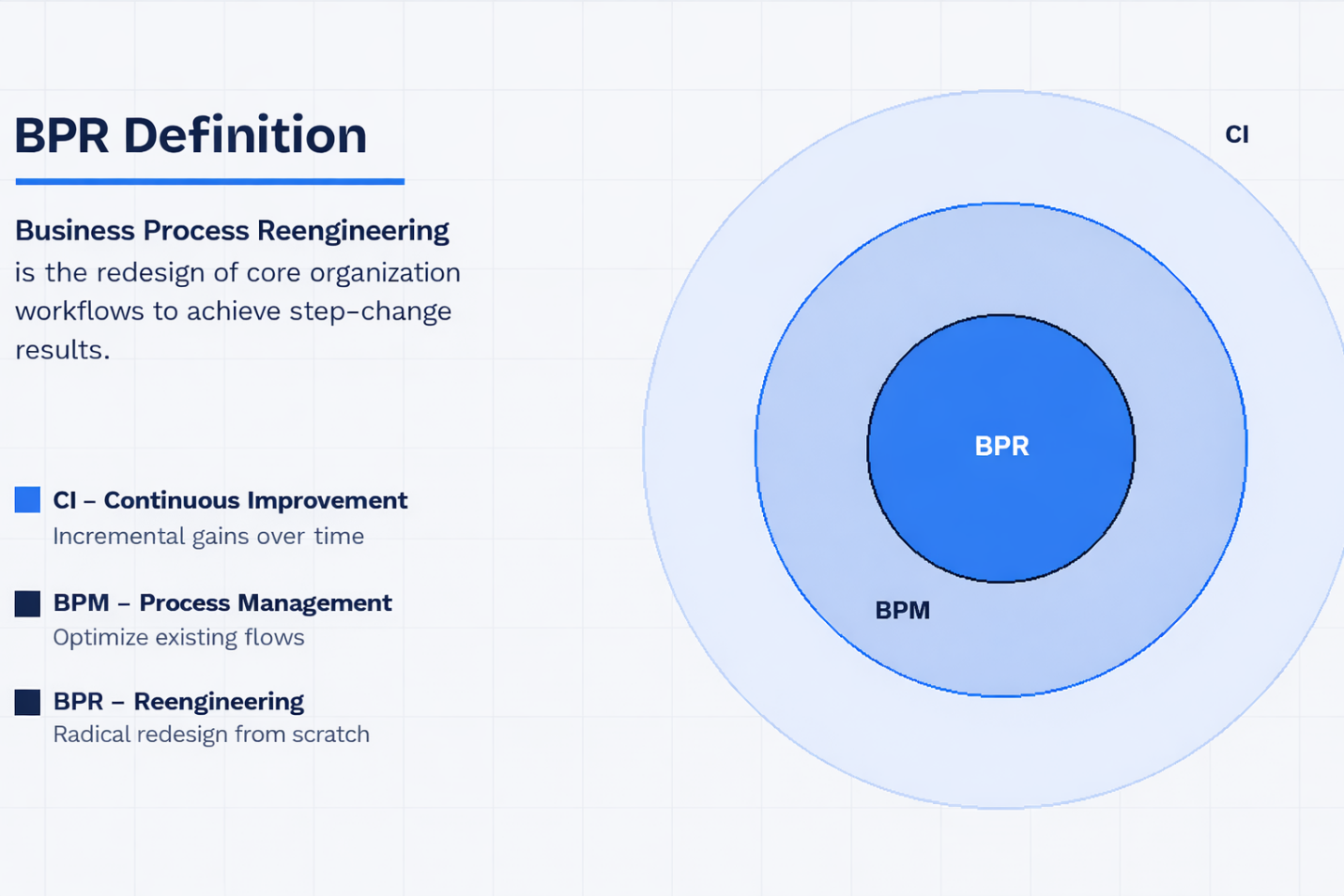
- Continuous Improvement: Small, incremental changes applied to an existing process over time.
- Business Process Management (BPM): Monitoring, modeling, and optimizing existing workflows through automation and analytics.
- Business Process Reengineering (BPR): A redesign that abandons the outdated workflow processes entirely to create new, more effective workflows.
BPR is not about refining steps in a process; it’s about asking whether those steps should exist at all.
The Origins of Business Process Reengineering
Business process reengineering has its roots in early 1990s management theory. The concept crystallized through the work of Michael Hammer, whose 1990 Harvard Business Review article argued that organizations were using computers simply to automate broken processes rather than rethinking them entirely.
Together with James Champy, Hammer formalized the business reengineering definition into a complete methodology, arguing that companies needed to undergo radical change in order to remain competitive in a rapidly shifting economic landscape. Their core message: obliterate, don’t automate.
Decades later, this philosophy remains highly relevant, perhaps even more so, given the pace of digital disruption, AI adoption, and shifting customer expectations.
Key Principles That Define BPR
Whether you are defining BPR for internal stakeholders or developing a reengineering roadmap, these foundational principles must guide the effort:
1. Outcomes First, Processes Second
Effective BPR starts by defining what success looks like for customers, stakeholders, and the business, before evaluating any existing workflows. This prevents the common trap of optimizing around internal convenience rather than actual value delivery.
2. Radical, Not Incremental
The process of reengineering implies significant disruption, but BPR is not about trimming the edges. It demands the courage to eliminate entire steps, restructure processes, and question every assumption about how work flows through the organization.
3. Cross-Functional Scope
Because BPR targets end-to-end processes, it requires collaboration across teams, disciplines, and leadership levels. No single department can drive a BPR initiative in isolation.
4. Technology as an Enabler
Modern BPR initiatives are now starting to harness AI, robotic process automation (RPA), cloud infrastructure, and advanced analytics; not to accelerate broken processes, but to make fundamentally better ones more achievable with shorter design and development timelines.
5. Sustained Governance and Measurement
What is business process reengineering without a way to know if it worked? Defining clear KPIs (cycle time, defect rate, customer satisfaction, cost per transaction) and building monitoring into the new process is essential for continuous process improvement.
Signs Your Organization Needs Business Process Reengineering
Not every operational problem calls for full-scale BPR. But certain patterns suggest that incremental fixes won’t be sufficient:
- Customer complaints are persistent and rising despite multiple improvement attempts.
- Key operations collapse whenever critical employees are absent.
- Costs continue to climb even as revenue stagnates or declines.
- Time-to-market or fulfillment speed is consistently lagging behind competitors.
- Staff morale is low due to repetitive or inefficient workflows.
- Compliance and governance failures keep recurring despite corrective actions.
If several of these apply simultaneously, reengineering a fundamental rethink is likely the right prescription.
The Business Process Reengineering Framework: Step by Step
Understanding the definition of business process reengineering is only the beginning. Executing it requires a disciplined, phased approach:
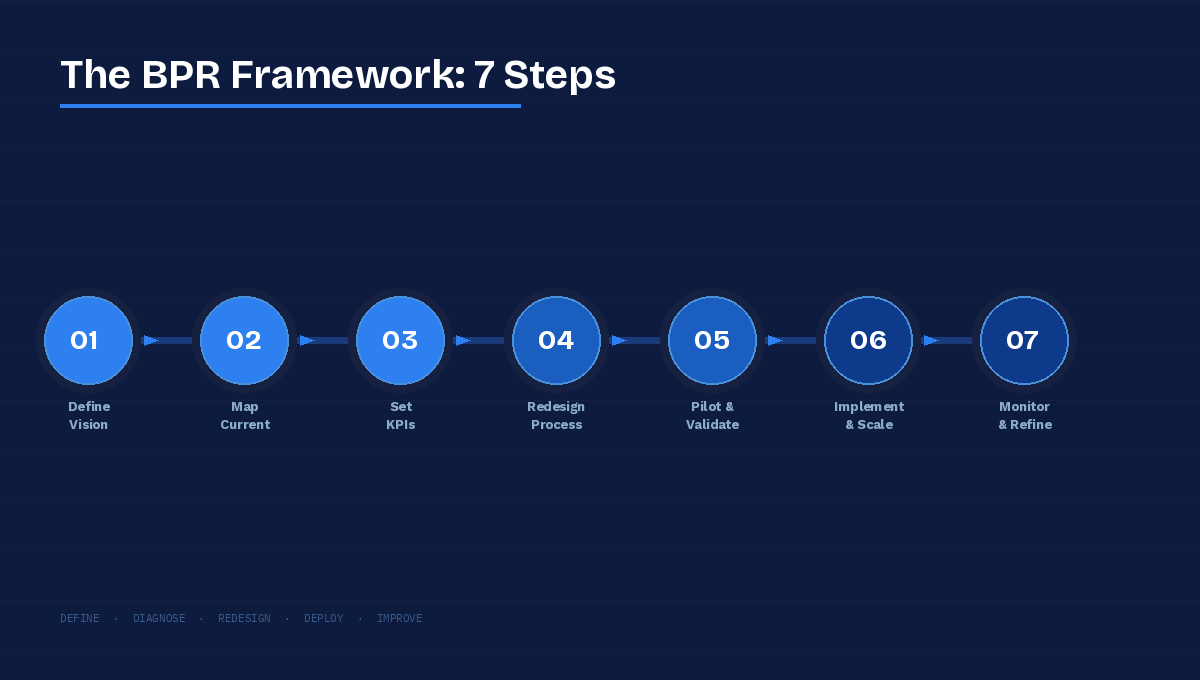
- Define the Strategic Vision: Clarify what the organization needs to achieve (i.e., reduced cycle time, lower costs, higher customer satisfaction) and which processes are most critical to those outcomes.
- Map and Analyze Current Processes: Document every step of the existing workflow, identify handoff points, and use process mining tools to pinpoint where delays, redundancies, and failures concentrate.
- Establish Performance Baselines and KPIs: Measure the current state objectively. Without baseline data, it’s impossible to evaluate whether reengineering efforts have actually delivered improvement.
- Redesign the Process: Cross-functional teams collaborate to design a new workflow from scratch, guided by the target outcome, not the constraints of the existing system.
- Pilot and Validate: Before rolling out at scale, test the redesigned process in a controlled environment. Gather stakeholder feedback, identify failure points, and refine accordingly.
- Implement and Scale: Roll out the new process with appropriate change management support, training, and communication. Ensure all dependencies, including technology, staffing, and integrations, are in place before go-live.
- Monitor, Evaluate, and Refine: Track KPIs against the baseline established in Step 3. Use ongoing analytics to ensure performance gains are sustained and to identify further optimization opportunities.
Technologies That Power Modern BPR
Today, enacting BPR is dramatically different from what Hammer and Champy detailed in 1993. The tools available now make radical redesign faster, safer, and more data-driven than ever:
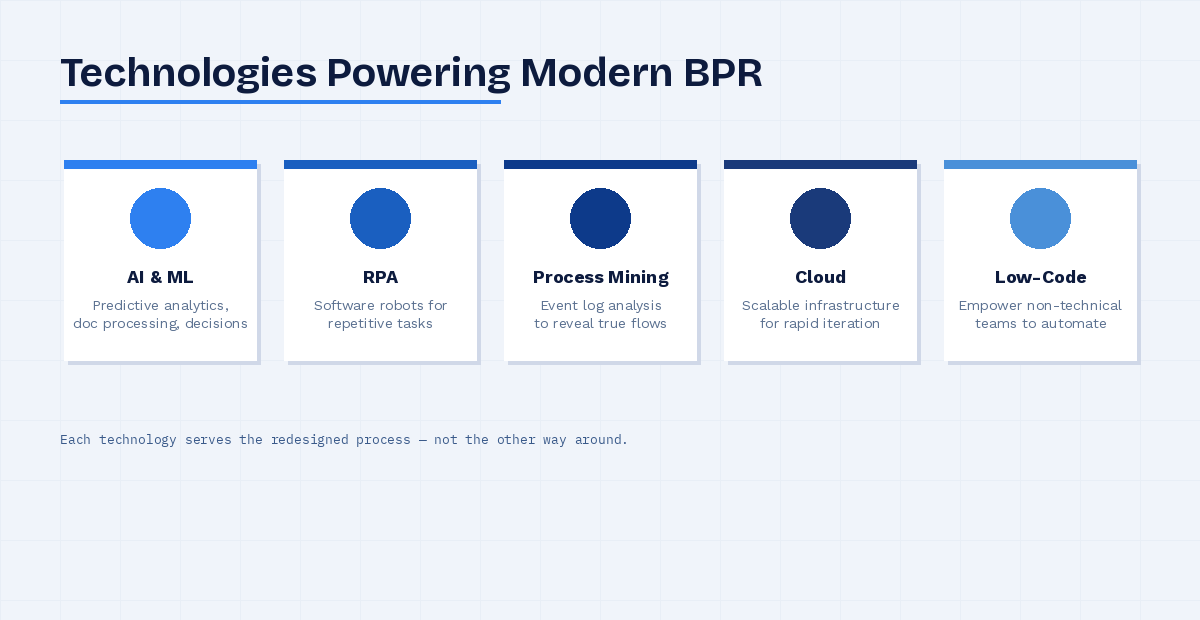
- Artificial Intelligence and Machine Learning: Used for predictive analytics, intelligent document processing, decision support, and anomaly detection within workflows.
- Robotic Process Automation (RPA): Software robots that handle repetitive, rule-based tasks across legacy systems, freeing human workers for higher-value work.
- Process Mining: Analyzes event logs from enterprise systems to reveal how processes actually operate, versus how they are assumed to work.
- Cloud Platforms: Provide the scalable infrastructure needed to deploy, test, and iterate on reengineered processes without significant capital investment.
- Low-Code / No-Code Workflow Automation: Empowers non-technical teams to design, deploy, and modify workflows without relying on developer resources for every change.
Common Pitfalls in BPR and How to Avoid Them
Even with a strong BPR definition guiding the project, organizations routinely stumble over the same obstacles. Awareness is half the battle:
- Scope Creep: BPR projects attract expanding lists of stakeholder requests. Define a narrow, outcome-focused scope from the outset and manage change requests through a structured governance process.
- Resistance to Change: Employees who fear displacement or distrust new systems will undermine adoption. Invest in transparent communication, early involvement, and internal champions who can model and advocate for the changes.
- Siloed Data and Fragmented Systems: BPR initiatives fail when automation bots and analytics tools can’t access unified data. Prioritize integration architecture and API-first connectivity before launching redesign efforts.
- Treating BPR as a One-Time Project: Business process reengineering means committing to an ongoing cycle of measurement, learning, and refinement; not a single implementation event.
Measuring BPR Success: The Metrics That Matter
Measuring outcomes is inseparable from the definition of business process reengineering. Key performance indicators should be defined before the redesign phase begins and tracked continuously afterward:
- Cycle Time Reduction: How much faster does the reengineered process complete compared to the original?
- Cost Per Transaction: Has the unit cost of completing a process activity decreased meaningfully?
- Error and Defect Rate: Are quality failures declining as a result of the redesign?
- Customer Satisfaction (CSAT / NPS): Are end customers experiencing measurably better outcomes?
- Employee Engagement: Are teams reporting higher clarity, reduced friction, and greater job satisfaction?
- Return on Investment (ROI): Do the financial benefits of reengineering justify the cost and disruption of the initiative?
The Honest Pros and Cons of BPR
Any balanced look at the business reengineering definition should acknowledge both the transformative potential and the very real risks:
Advantages:
- Delivers step-change performance improvements, not just marginal gains.
- Eliminates deeply embedded inefficiencies that incremental methods cannot reach.
- Creates a foundation for scalable, technology-enabled operations.
- Positions the organization to meet rapidly evolving customer and competitive demands.
Risks:
- High upfront investment in time, resources, and organizational energy.
- Significant disruption to day-to-day operations during the transition period.
- Potential for unintended consequences if the redesign is not rigorously tested.
- Cultural resistance that can derail even technically sound redesign efforts.
Conclusion: BPR Is Not a Last Resort — It’s a Strategic Choice
Understanding how business process reengineering can help your organization fundamentally adapt to changing business needs is the first step towards better processes, workflows, and greater productivity.
Whether you are exploring BPR for the first time or looking to refresh a stalled initiative, the core insight remains unchanged: dramatic performance improvement rarely comes from doing the same things better. It comes from doing fundamentally different things and doing them well.
With MS Technology’s eViewer and document solutions, you get a unified, browser-based platform for intelligent document viewing, AI-powered features, and seamless integration, enabling you to provide a successful solution to your BPR initiative.
While eViewer is purpose-built for intelligent document viewing and management, successful BPR initiatives often require robust workflow automation capabilities to manage end-to-end process changes across the enterprise. This is where eViewer plays a critical role with seamless integration capabilities that deliver a truly robust, end-to-end solution for platforms like IBM and Microsoft.
IBM Business Automation Workflow enables organizations to model, automate, and monitor complex, multi-step workflows across departments and systems. When eViewer is integrated with IBM’s automation environment, document-centric tasks such as approvals, reviews, comparing documents, and compliance checks are handled directly within the workflow, eliminating the friction of context-switching between systems and accelerating process cycle times.
Microsoft Power Automate offers a flexible, low-code automation layer that connects hundreds of enterprise applications and services through pre-built connectors and customizable workflows. eViewer integrates seamlessly with Microsoft’s environment, allowing teams to trigger document workflows, route files for review, and capture annotations and approvals, all within the familiar Microsoft stack.
The result is a best-of-breed architecture: eViewer delivers high-fidelity document viewing, AI-powered features, and secure governance, all integrated as a unified experience. With eViewer’s open integration architecture, architects can integrate eViewer into any newly developed business process workflow.
Want to know more about eViewer? Please visit https://eviewer.net/ or contact us at info@ms-technology.com

Share This Article